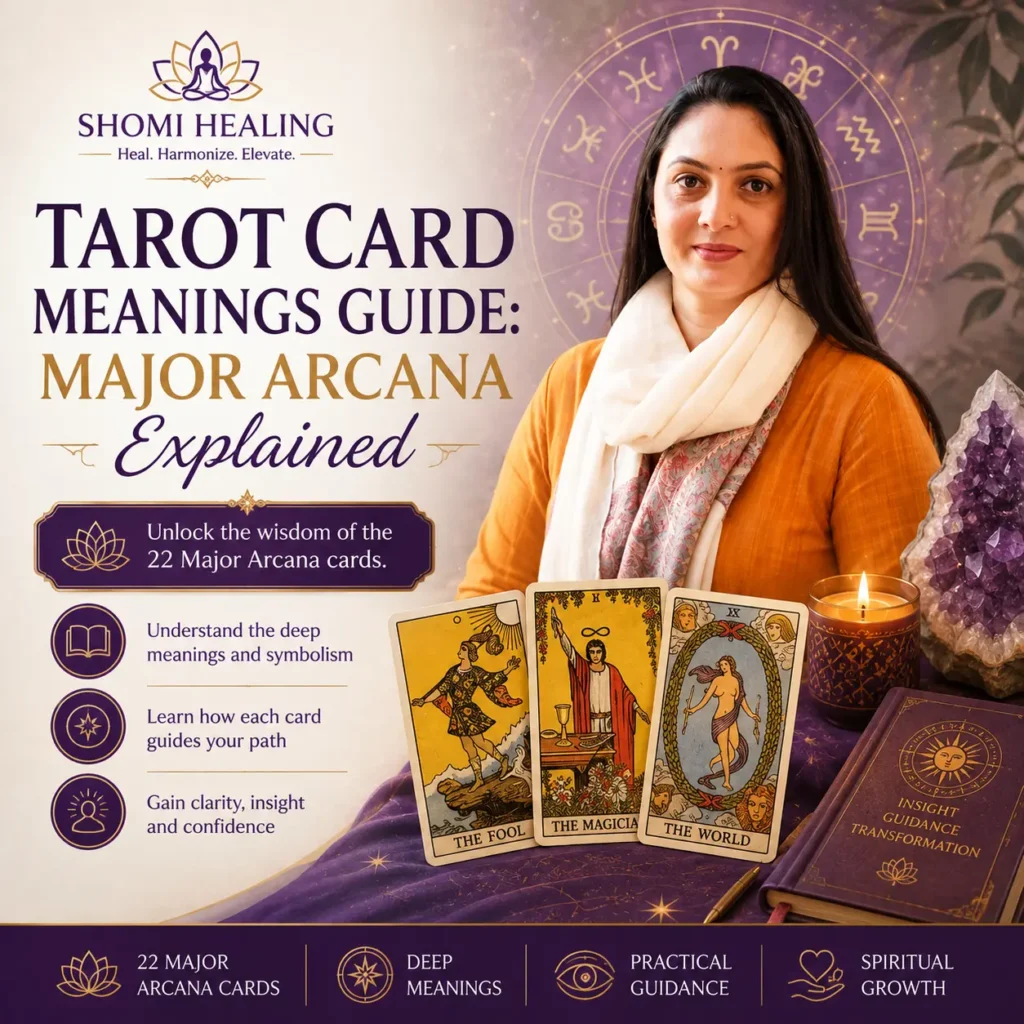
Searching for tarot card meanings can feel overwhelming when you first discover the deck. However, learning the Major Arcana gives beginners a strong foundation.
The Major Arcana contains twenty-two cards, numbered from The Fool through The World. Together, these cards represent themes such as beginnings, choices, challenges, transformation, and completion.
Moreover, each card can carry different meanings depending on its position and surrounding cards. Therefore, memorizing one fixed definition for every card is not always enough.
Tarot also differs from oracle cards in structure and reading style. Understanding that difference can help you choose the right consultation or learning approach.
This guide explains the Major Arcana in simple language. Additionally, it compares tarot and oracle cards so you can decide what suits your needs.
The Fool
The Fool represents beginnings, curiosity, freedom, and willingness to explore. Therefore, this card often appears when someone stands before an unfamiliar path.
However, The Fool can also suggest impulsiveness when preparation is missing. In a reading, consider whether enthusiasm needs to be balanced with awareness.
The Magician
The Magician represents ability, initiative, communication, and focused action. Moreover, it can remind you that existing skills may already provide useful resources.
Therefore, this card often encourages confidence and intentional effort. However, it can also warn against manipulation or using abilities without integrity.
The High Priestess
The High Priestess represents intuition, inner knowledge, mystery, and quiet observation. Consequently, the card may suggest pausing before making an immediate decision.
Also, it can encourage you to notice subtle feelings and information. Sometimes, silence provides useful insight before action becomes necessary.
The Empress
The Empress represents nurturing, creativity, abundance, comfort, and growth. Therefore, it may appear when something needs patience and supportive attention.
Moreover, the card can relate to creativity, relationships, family, or personal wellbeing. However, excessive comfort can sometimes become avoidance.
The Emperor
The Emperor represents structure, authority, stability, responsibility, and leadership. Consequently, this card may encourage stronger boundaries or organized planning.
However, it can also highlight rigidity or excessive control. Therefore, consider whether structure is supporting growth or limiting flexibility.
The Hierophant
The Hierophant represents tradition, learning, guidance, shared beliefs, and established systems. Also, it can point toward teachers, mentors, or formal learning.
However, the card may encourage you to question whether inherited beliefs still serve your situation. Therefore, balance tradition with personal understanding.
The Lovers
The Lovers represents connection, values, choices, and alignment. Although often associated with relationships, the card can also concern important life decisions.
Therefore, ask whether your choice reflects your deeper values. Moreover, healthy connection requires honesty, responsibility, and mutual understanding.
The Chariot
The Chariot represents determination, direction, discipline, and controlled movement. Consequently, it may suggest committing to a goal despite competing pressures.
However, force alone is not enough. Therefore, balance ambition with emotional awareness and a clear sense of direction.
Strength
Strength represents courage, patience, compassion, and inner resilience. Rather than physical force, the card often emphasizes calm confidence.
Moreover, it can suggest managing difficult emotions without suppressing them. Therefore, gentle persistence may achieve more than aggressive action.
The Hermit
The Hermit represents introspection, solitude, wisdom, and thoughtful searching. Consequently, it can encourage stepping away from distractions temporarily.
However, isolation should not become avoidance. Therefore, use quiet time to understand yourself before returning to important conversations or decisions.
Wheel of Fortune
The Wheel of Fortune represents cycles, change, movement, and shifting circumstances. Therefore, it can suggest that current conditions may not remain permanent.
Moreover, the card encourages adaptability when circumstances change. Instead of controlling every outcome, focus on how you respond.
Justice
Justice represents fairness, truth, accountability, and consequences. Consequently, this card often asks you to examine facts before reaching conclusions.
Also, it can encourage honest communication and responsible choices. Therefore, consider both your actions and their possible results.
The Hanged Man
The Hanged Man represents pause, surrender, perspective, and seeing situations differently. Rather than pushing forward, it may suggest waiting or reconsidering.
Therefore, a temporary pause can create valuable clarity. However, surrender does not mean giving up; it can mean releasing an unhelpful approach.
Death
Death represents transformation, endings, release, and renewal. Despite its dramatic name, the card does not literally predict physical death.
Instead, it often symbolizes the end of one phase and the beginning of another. Consequently, accepting change can create room for growth.
Temperance
Temperance represents balance, patience, moderation, integration, and harmony. Therefore, it can suggest combining different priorities without allowing one area to dominate.
Moreover, gradual progress may be more sustainable than extreme action. This card often favors thoughtful adjustment and emotional steadiness.
The Devil
The Devil can represent attachment, temptation, unhealthy patterns, fear, or perceived limitations. However, it does not automatically mean something negative will happen.
Instead, the card may encourage you to identify what controls your choices. Therefore, awareness can become the first step toward changing an unwanted pattern.
The Tower
The Tower represents disruption, revelation, sudden change, and the breakdown of unstable structures. Consequently, it can feel uncomfortable when familiar assumptions are challenged.
However, disruption can reveal what needs rebuilding. Therefore, focus on truth and necessary change rather than only fearing uncertainty.
The Star
The Star represents hope, renewal, inspiration, healing, and optimism. Moreover, it can appear after difficult experiences when confidence slowly returns.
Therefore, the card encourages patience and trust in gradual recovery. It can also highlight authenticity and emotional openness.
The Moon
The Moon represents uncertainty, intuition, dreams, emotions, and incomplete information. Consequently, it reminds you to avoid making strong conclusions without enough clarity.
Also, fears can feel larger when information is limited. Therefore, pause, verify important facts, and observe your emotional reactions.
The Sun
The Sun represents clarity, confidence, joy, vitality, and positive visibility. Therefore, it often brings an encouraging theme to a reading.
Moreover, the card can suggest openness and honest expression. However, confidence works best when it remains grounded in reality.
Judgement
Judgement represents reflection, awakening, accountability, and important realizations. Consequently, it can indicate a period of reviewing past choices.
Rather than encouraging guilt, the card can support learning and renewed direction. Therefore, use past experiences as information for future decisions.
The World
The World represents completion, achievement, integration, and the closing of a meaningful cycle. Therefore, it can signal that one chapter is reaching maturity.
Moreover, completion can create the opportunity for a new beginning. Celebrate progress while remaining open to the next stage.
Tarot vs Oracle Cards
Tarot and oracle cards can both support reflection, but their structures are different. Traditional tarot usually follows a structured system containing seventy-eight cards.
In contrast, oracle decks can contain different numbers of cards and themes. Therefore, each oracle deck may have its own meanings and interpretation style.
Moreover, tarot offers a consistent framework that many learners appreciate. Oracle cards can feel more flexible because the creator determines the deck’s structure.
Neither system is automatically better. Instead, your choice depends on your purpose, preferred symbolism, and consultation style.
How to Choose Between Tarot and Oracle
First, choose tarot if you enjoy structured symbolism and want to learn a traditional system. Conversely, choose oracle cards if you prefer flexible themes and intuitive messages.
However, many readers use both systems together. For example, tarot may provide detailed context while an oracle card offers a broader reflection.
Therefore, you do not need to choose permanently. Explore both approaches and notice which method helps you ask clearer questions.
Conclusion
Learning tarot card meanings becomes easier when you understand themes instead of memorizing isolated keywords. Moreover, context, card position, and personal circumstances influence interpretation.
Similarly, understanding tarot versus oracle cards helps you choose a method that matches your expectations. Ultimately, the most useful reading encourages reflection, clarity, and thoughtful choices rather than fear or dependency.